
Implementation of temperature tests on laboratory centrifuges
State of the art & definition of the Mesurande:
This is a dynamic measurement of air temperature at a stable rotation speed at critical points of the hollow cylinder drawn by the mobile assembly (racks) accommodating the samples.
It has been shown that The nature of the samples has no impact on the average temperature at each point in the system (the only phenomenon observed: the decrease in the amplitude of the oscillations).
It has been shown that the critical points are located at the edges of the system (location of hot and cold spots varies according to the centrifuge models) and that the temperature heterogeneity is identical in each rack (which allows the sensors to be distributed in the different racks of the installation).
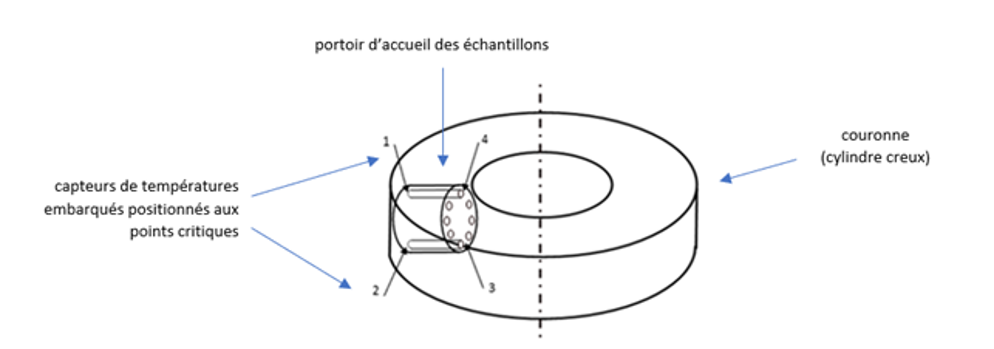
Dynamic schematic of a support for installation in a free rotor (or star rotor)
Conditions of use that impact thermal behavior: the use or not of casings, the rotation speed.
The acquisition frequency must be adapted to the duration:
– Programs used (from 5 to 30 minutes); ;
– Oscillations; ;
– Data that has been processed.
Proposal of a consistent value: 10s.
Established regime and transitional regime
The transient regime study allows validation of the pre-conditioning strategy for the equipment and its accessories (pre-centrifugation step).
Generally two strategies are adopted: preserving the racks in a thermostatically controlled chamber (with the samples) or in the centrifuge (with the elements of the rotor assembly). Mastering this step is crucial, as the heat exchange between the samples and the racks is very rapid and significant. due to the significant thermal mass.
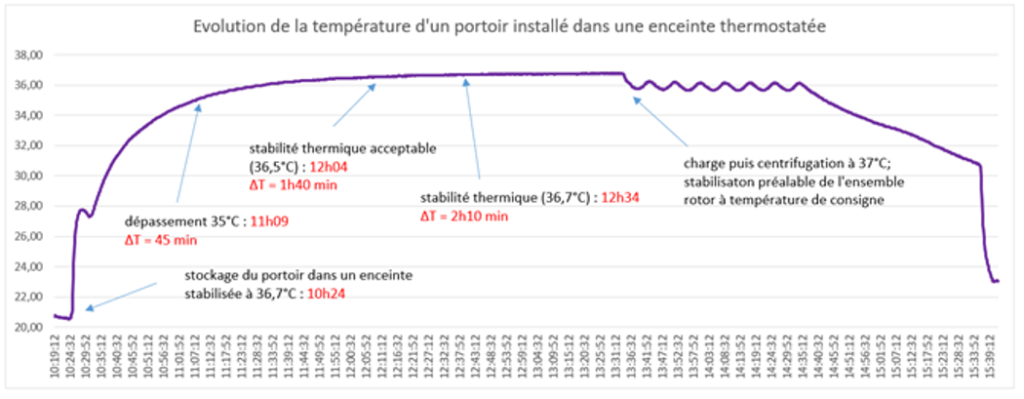
Thermal stabilization of a rack from ambient temperature to 37°C
Temperature monitoring at the 4 critical points of the system: pre-established regime in the chamber – load simulation – transient regime then recovery of a steady-state regime:
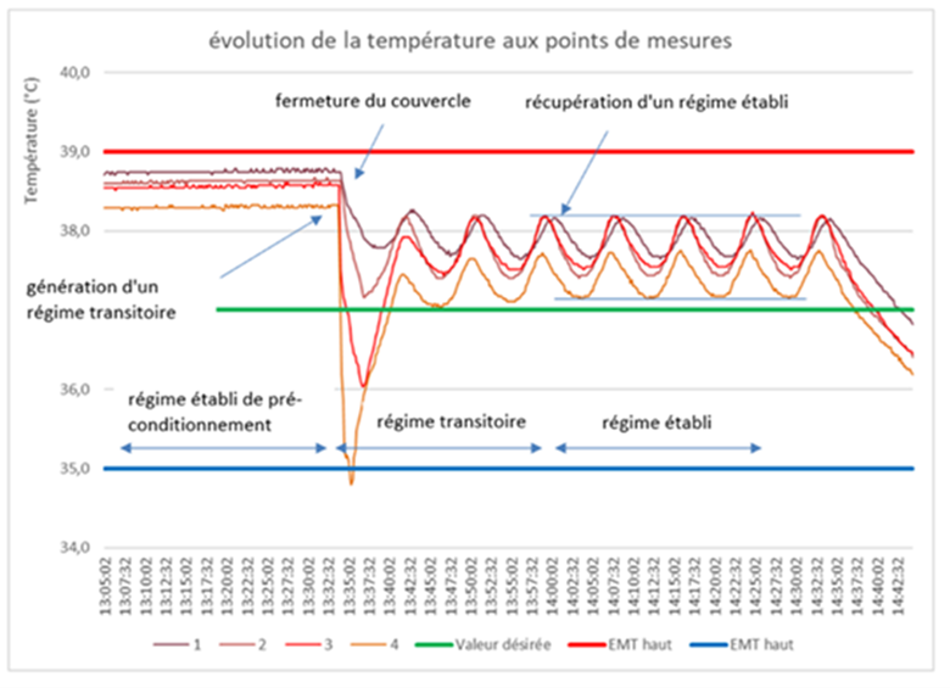
Example of a transient regime study at 37°C
Key information provided in the transitional regime report:
– Preconditioning strategy; ;
– Duration of the disturbance (simulated charging time); ;
– Recovery time from an established regimen; ;
– Maximum measured value and duration of exceedance where applicable.
The study of the established diet allows us to determine the conformity of the equipment.
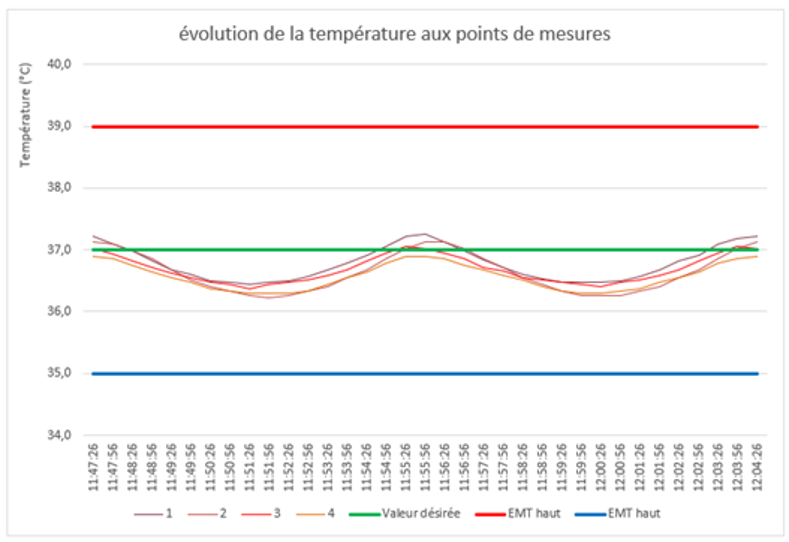
Example of a system established for a setpoint of 37 +/- 2°C
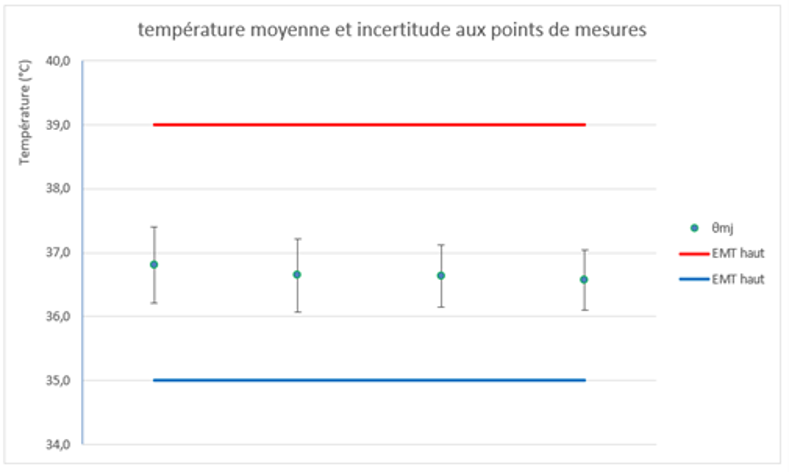
Temperature disparity, uncertainty (measurement + stability) and conformity at each point
Key information provided on the established regime reports:
For each measurement point (each sensor j):
– Average value (θmj); ;
– Standard deviation (sj); ;
– Compound uncertainty (ucj); ;
– Expanded uncertainty (Umj = umj * k).
Results based on the average:
– Desired temperature (θdes); ;
– Average air temperature in the enclosure = spatio-temporal average (θair); ;
– Expanded uncertainty associated with the mean air temperature (U); ;
– Setpoint temperature (θco); ;
– Setpoint deviation (Δθco); ;
– Indicated temperature (θin); ;
– Error of the indicator (Δθin); ;
– Minimum and maximum permissible errors (MPE); ;
– Judgment of conformity (in the case of verifications).
Test program
It has been shown that current centrifuge technologies do not allow for the definition of a limited characterization program representative of the equipment's performance for its operating range ("non-specific" use). The predominant impact of rotational speed on temperature regulation necessitates characterizing each speed-temperature pair ("specific" use).
Reference frameworks
Scope: Equipment covered by the method are defined by the standard EN 61010-2-020 Safety requirements for electrical measuring, control and laboratory equipment / Part 2-020: Particular requirements for laboratory centrifuges.
Temperature characterization: FD X15-140 Air humidity measurement – Climatic and thermostatic chambers – Characterization and verification : Borrowing of terms, definitions, symbols and abbreviations.